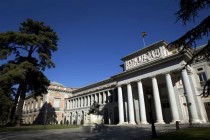
| Spain |
Madrid |
Museo Nacional del Prado |
26. |
1638 |
|
|
Art
|
More |
Museo Nacional del Prado was founded in 1819.
The collection includes works from the royal collection, collected from the 16th to the 20th century.
- Spanish painting - from Romanesque art to the 20th century, you can find works of artists such as: El Greco, Diego Velázquez, Francisco Goya, Pablo Picasso, the works of Velazquez (almost 50 works) and Goya (over 140 paintings) are most widely represented,
- Italian painting - from the 15th to the 18th century, the best collection of paintings from the Venetian school, including works of Titian, Veronese and Tintoretto,
- Flemish painting - from the 15th to the 17th century, presentation of the works of Rogier van der Weyden, Bosch,
- French painting - from the 16th to the early 19th century, e.g. paintings by Poussin and Lorrain,
- Greek sculpture - two original sculptures from the archaic period (including kuros from the 6th century BC), Roman copies of the works of Greek masters from the classical period (a miniature copy of Athena Partenos by Fidias, a copy of Athena Myron from the group Athena and Marsia,
- a collection of drawings from the 15th to the 19th century, the Spanish school looks best here (including Goya), but you can also find drawings by Michelangelo,
- graphics - a rich collection consists of Franco Goya's cycles.
|
| Spain |
Madrid |
Reina Sofía |
60. |
2083 |
|
|
Art
|
More |
Reina Sofía was opened in 1990.
It presents contemporary Spanish art in an international context from the end of the 19th century to the present day. Pablo Picasso's painting Guernica from 1937 is exhibited in Reina Sofía. Other artists whose artistic achievements are in the collection of Reina Sofía are, for example: Salvador Dali, Joan Miró, Juan Gris, Georges Braque, Francis Bacon, Alexander Calder, René Magritte, Robert Delaunay, Man Ray and Yves Klein.
The collection comprises over 20,000 works, five percent of which are on display.
The museum also houses an art library with over 100,000 books.
|
| Spain |
Madrid |
Museo Nacional Thyssen-Bornemisza |
95. |
3400 |
|
|
Art
|
More |
The Museo Nacional Thyssen-Bornemisza opened in 1992.
The collection includes 800 years of Western art; about 1,600 paintings by, among others, Van Eyck, Dürer, Caravaggio, Rubens, Van Dyck, Rembrandt, Goya, Delacroix, Van Gogh, Pissarro, Munch, Chagall, Pollock, Rothko, Bacon.
|
| Spain |
Madrid |
Palacio Real de Madrid |
208. |
301 |
|
|
Historic house
|
More |
Palacio Real de Madrid (Royal Palace of Madrid) built between 1735-1764 in the classical baroque style. It is the official residence of the Spanish royal family and the largest royal palace in Western Europe. It has 3,418 rooms and covers an area of 135,000 square meters.
The palace is decorated with frescoes by Giovanni Battista Tiepolo and Anton Raphael Mengs. The interiors exhibit oil paintings by artists such as Caravaggio, Francisco de Goya, Velázquez and a set of five string instruments made by Antonio Stradivari (Stradivarius Palatinos). The palace houses, among others, the Royal Armory and the Crown Room.
The origins of the museum date back to 1935.
|
| Spain |
Madrid |
National Museum of Anthropology |
390. |
346 |
|
|
Anthropology, archeology,... ethnography
|
More |
The National Museum of Anthropology (Museo Nacional de Antropología) is a pioneering institution dedicated to cultural diversity and social anthropology. It is one of the oldest anthropological museums in Spain, known for its extensive, globally sourced collections presented in a 19th-century building.
The museum was founded through the personal initiative of Segovian physician Dr. Pedro González Velasco and inaugurated by King Alfonso XII on April 29, 1875, originally as the Anatomical or Anthropological Museum.
The museum houses items representing the tangible culture of societies from Africa, America, Asia, Europe, and Oceania. Key collections include ethnographic artifacts from the Philippines (from the 1887 exhibition), Equatorial Guinea, and a significant physical anthropology collection, including skulls and skeletons from the 19th century. Notable items include the skeleton of the "Extremaduran Giant" (Agustín Luengo Capilla).
The museum holds more than 20,000 to 21,000 ethnographic and archaeological artifacts.
The museum is organized over three floors and five main exhibition rooms.
|