


Visitors experience the Tapestry as it has never been seen before when it's displayed flat for the first time and in one continuous length in a specially made show case.
In previous permanent displays the Tapestry has been displayed vertically and from 1700 until 1842 it was usually rolled out for academics and important individuals to see. Displaying the Tapestry flat allows audiences to fully appreciate the scale of this spectacular and one-of-a-kind medieval embroidery. It also enables the Museum to bring it to life in a new and imaginative way with digital elements helping enhance understanding.
The show will be supported by objects from the Museum's own collection, alongside significant loans from UK and European partners, putting the Tapestry into the broader context of medieval England and the events surrounding the Norman Conquest.
In exploring the background to the Bayeux Tapestry, loans include a charter of Edward the Confessor of 1060 granting lands in Wheathampstead, Hertfordshire, to Westminster Abbey. The document, written in Latin and Old English, is witnessed by several individuals who appear in the Tapestry, including King Edward 'the Confessor', Harold's sister, Queen Edith, Archbishop Stigand, Earl Harold and his brother Gyrth; both shown in the Tapestry being killed at the Battle of Hastings.
An extensively illustrated manuscript known as Junius II will also feature from the Bodleian Libraries, University of Oxford. It records biblical events and was likely borrowed by the Tapestry's creators for their depictions of clothing, ships and items of everyday life. Importantly, the manuscript was likely created in Canterbury, possibly at Christ Church, around AD 1000, so it would have been available to the Tapestry's designer.
Important for understanding the immediate impact of the Norman Conquest – a theme explored by the British Museum show – is a hoard of silver pennies of Harold II and William I known as the Chew Valley Hoard on loan from the South West Heritage Trust and Somserset Council museum collection, supported by The National Lottery Heritage Fund and Art Fund. Buried in the traditional county of Somerset soon after the Norman Conquest, experts believe it was buried for safekeeping during the rebellion against Norman rule in the south-west, which, in 1068, saw Exeter 'fight for its liberty': William suppressed the rebellion.
Also on display, a charter issued by William I in 1067 soon after he became king, to the citizens of London. The document, provided by the London Archive, part of the City of London Corporation, is written in Old English, the language of the newly conquered English, and promises the English that the new king will uphold the laws and customs of King Edward. Its message, therefore, stands in contrast to the political realities of 1066 inferred by the Chew Valley Hoard, where the English feared for the future.
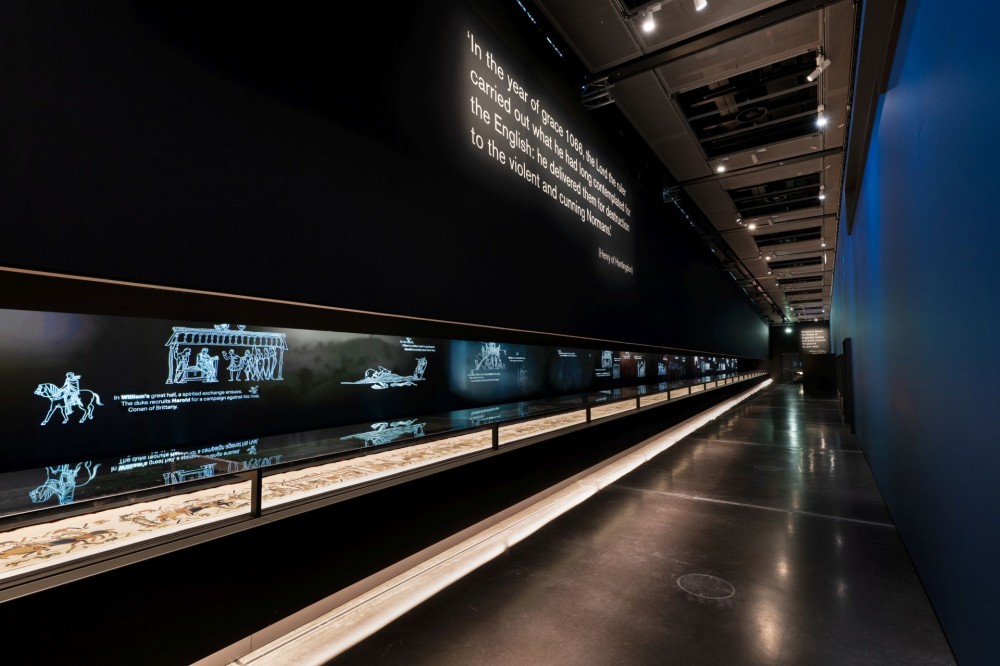
Bayeux Tapestry Exhibition © The Trustees of the British Museum
Dr Nicholas Cullinan OBE, Director of the British Museum, said: 'The Bayeux Tapestry is one of the most important surviving works from the medieval world and an extraordinary account of a defining moment in our history.
'Since we first announced this historic loan, we have been committed to ensuring as many people as possible can see it, and we're excited about welcoming the first visitors through the doors on the 10th of September.'
Igor Tulchinsky, Founder, Chairman, and Chief Executive Officer of WorldQuant, said: 'One of the reasons I decided to sponsor this crucially important exhibition of British history was to allow art to be seen and to change the lives of those who see it.
'The embroidery demonstrates such a mastery of craft. The symmetries and proportions show careful calculation. Its chronological structure reveals something equally sophisticated: a modern sense of causality and sequence. It is a narrative about decisions made under uncertainty, about commitments made before their consequences can be known.
'I hope that the Tapestry inspires us all to recognize the value of what endures and to continue to dream about what we might build, what we might preserve, and what we might make possible for those who come after us.'
Michael Lewis, Curator: Bayeux Tapestry Experience, said: 'The display of the Bayeux Tapestry at the British Museum offers visitors a once in a lifetime opportunity to be part of history. This will be a new and exciting presentation of the Tapestry's story: the events leading to the Norman Conquest, an incredible moment that changed England forever.
'Important loans will help visitors fully appreciate the Tapestry, explaining why and how the embroidery was made. Also, that its retelling of events, though ambiguous, likely deliberately so, offers a unique perspective on the past. The Norman Conquest not only impacted kings, dukes and the elite, but also everyday people, including those who made this artwork.'
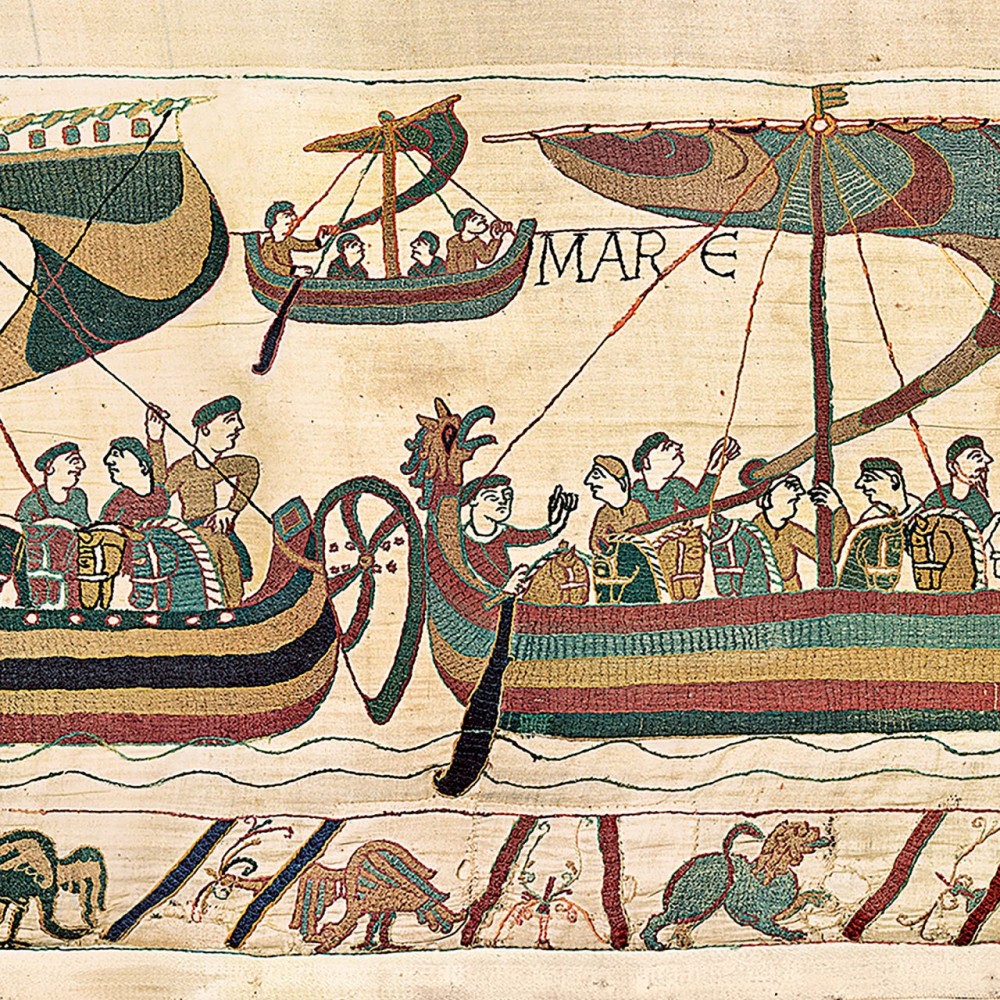
Bayeux Tapestry © LFPN A. Cazin
The Bayeux Tapestry
The Bayeux Tapestry is a 70-metre-long masterpiece telling the story of the events leading to the Battle of Hastings (14 October 1066) and the Norman Conquest of England by William, Duke of Normandy. The embroidery in wool thread on linen cloth was likely produced in or near Canterbury and dates to 1072–77.
Through 58 scenes, 627 characters and 737 animals, the Tapestry gives an account of the medieval period in Normandy and England like no other. It provides information about civil and military architecture, armour and seafaring, as well as precious details of everyday life.
The Tapestry has been on display at the Bayeux Tapestry Museum, Normandy, since 1983 until the museum closed in 2025 for renovation. This provided the circumstances for the Bayeux Tapestry to come to the UK. It will return to France for display in the new Bayeux Tapestry Museum following its display at the British Museum.