


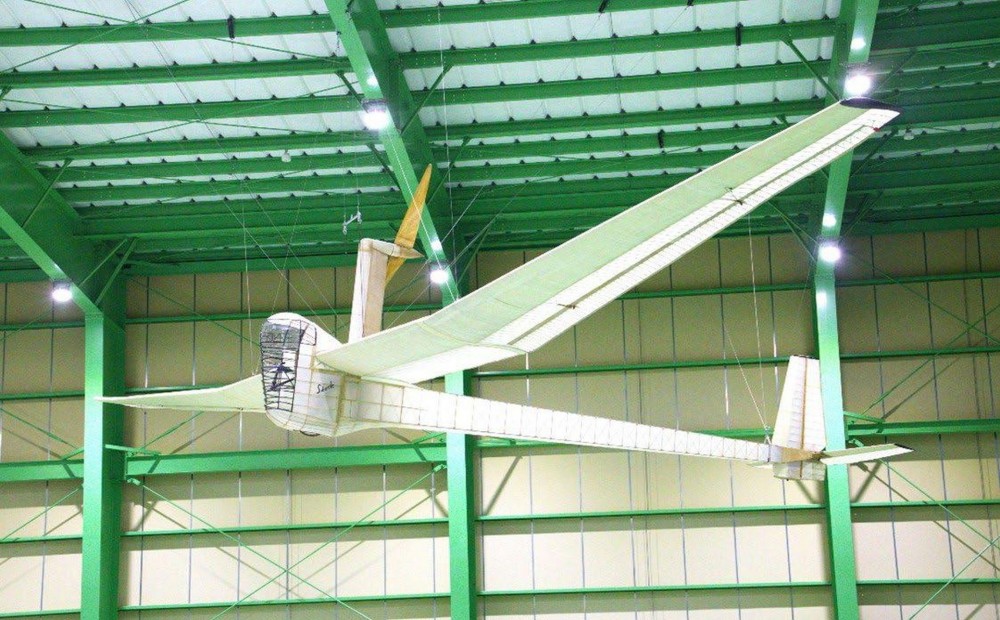
"Stork B" currently on display at the Hirosawa Aviation Museum, National Museum of Nature and Science
The "Stork" is a light aircraft developed and researched by students at Nihon University as their graduation project between 1975 and 1977. It set a then-world record (unofficial) for human-powered flight with a flight distance of 2093.9 m. The Japan Society for Aeronautical and Space Sciences highly praised the fact that the aircraft, which utilized unique Japanese manufacturing techniques such as washi paper, was entirely designed and built by a team of students, set a world record, and made it widely known to the world that flight is possible using only human power. As a result, many people have been inspired to design and build human-powered aircraft in an attempt to break the record, and it has also contributed to the training of aeronautical engineers. The aircraft is currently on public display at the Hirosawa Aviation Museum of the National Museum of Nature and Science, located in "The Hirosawa City" (Chikusei City, Ibaraki Prefecture).
On January 2, 1977, the Stork B (the earlier version of the same aircraft may be referred to as A, and the later version as B) flew 2093.9 m, setting a new world record for human-powered flight at the time. Since 1963, the College of Science and Technology at Nihon University had been conducting research on human-powered aircraft as graduation projects for students in the Department of Aeronautics. Following five Lynette models (Lynette II at 91 m) and three Egret models (Egret III at 203 m), the Stork model was created. The Stork B rolled out on February 29, 1976, and was named "Stork" by Professor Hidemasa Kimura. In March 1976, it broke the Japanese record (Stork A), and in December 1976, it broke the world record (Stork B, the same aircraft). Because it flies using only 0.3 to 0.4 horsepower, the Stork B weighs only 35.9 kg. Incidentally, the world's first human-powered aircraft, according to current definitions, was the Sunpak, built at the University of Southampton in the UK, which flew a distance of approximately 45 meters on November 9, 1961.
Specifications:
Manufacturer: College of Science and Technology, Nihon University
Seating Capacity: 1
Overall Length: 8.85 m
Overall Wingspan: 21 m
Main Wingspan: 21.70 m²
Total Weight: 35.9 kg
World records:
Flight duration record 4 minutes 43 seconds (December 31, 1976)
Flight distance record 2093.9 m (January 2, 1977)
However, at the time, human-powered aircraft were not included in the official records of the IAF (International Aeronautical Federation) and were not recognized.
About Aerospace Technology Heritage: The Japan Society for Aeronautical and Space Sciences (JSASS) recognizes groundbreaking products and technologies that have shaped the history of aerospace technology development in Japan, aims to pass them on to future generations, and contribute to the future development of aerospace technology. The JSASS designates these groundbreaking products and technologies as Aerospace Technology Heritage. The Japan Society for Aeronautical and Space Sciences Aerospace Technology Heritage website: https://branch.jsass.or.jp/isan/
About Hirosawa Aviation Museum (National Museum of Nature and Science): Established in March 2021 within the "Yumenoba" theme park at "The Hirosawa City" (Chikusei City, Ibaraki Prefecture), the Hirosawa Aviation Museum is a facility jointly run by the National Museum of Nature and Science and the Hirosawa Aviation Museum Foundation. It opened to the public in February 2024. In addition to the Stork B, the museum displays important aviation artifacts, including the first production model of the YS-11, Japan's only purely domestically developed civilian transport aircraft, a helicopter (Sikorsky S-58) used for Antarctic research, and a Zero fighter plane. The Hirosawa City website: https://www.shimodate.jp/index.html